
Squares, localities under siege
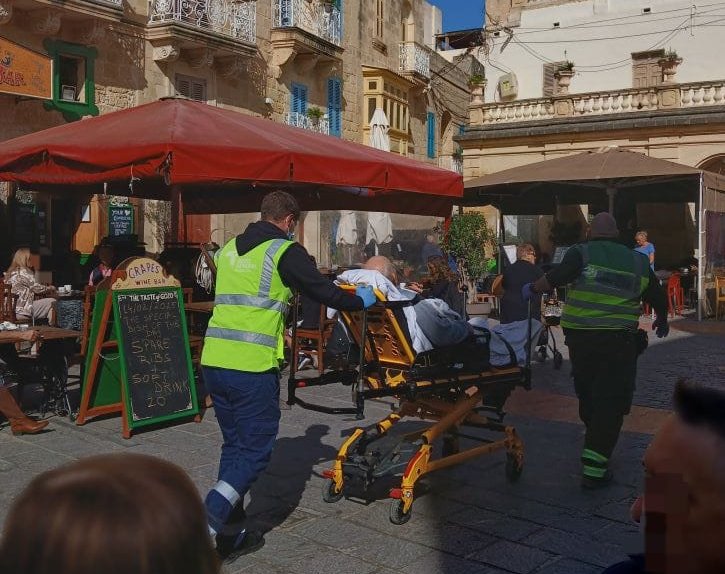
The news that an alarm system will be installed in Victoria’s St George’s Square to prompt businesses to clear tables and chairs so an ambulance can pass borders on the absurd. One cannot help but ask: how did we get to the point where an alarm is needed to warn of another alarm?
Ambulances already come with sirens – an internationally recognised sound of urgency that cuts through traffic and crowds alike. But evidently, this siren is being ignored in the chaos of a square now repurposed into an open-air restaurant, its space increasingly consumed by private profit rather than public utility. The solution? Not enforcement. Not redesign. But yet another noise: an alarm to signal that the ambulance siren is being ignored. It’s a scenario that would be comical if it weren’t so dangerously misguided.
At the heart of the matter is the ongoing occupation of public space. St George’s Square has in recent years become a symbol of the creeping erosion of the public realm. What was once a civic space, in front of a historic basilica, has been gradually carved up to serve commercial interests. Tables, chairs, parasols – all arranged with little apparent regard for accessibility, emergency access, or the simple right of a citizen to occupy public ground unencumbered.
The arrangement is not just absurd. It’s dangerous. The Gozo General Hospital, just five minutes away, will sound this new alarm if an ambulance requires access. Five minutes. That’s five minutes during which waiters must react, patrons must rise, furniture must be cleared, and an access route must be made – assuming, of course, that the alarm works as intended, is heard in time, and that the square is not jammed to the point of paralysis. Every lost second in an emergency can cost a life. Instead of streamlining access, we’ve created another obstacle.
This ridiculous workaround exposes a deeper problem: the inability or unwillingness of authorities to enforce reasonable limits on how public space is used. The obvious solution is to ensure that there is always an accessible corridor for emergency vehicles – something entirely feasible through proper planning and regulation. No one is arguing against outdoor dining. But it must be balanced, regulated, and designed around core civic priorities – public safety chief among them.
And yet, the long-promised masterplan for this square remains absent. The longer it is delayed, the more this kind of farcical improvisation fills the void. A masterplan must be exactly that – a coherent, enforceable strategy that respects the square’s historical, civic, and emergency roles, not a smokescreen to preserve the status quo.
Unfortunately, Victoria is not alone. Across Malta and Gozo, public spaces and entire localities are being held hostage to accommodate commercial or entertainment ventures. The recent ordeal faced by residents of Floriana during large-scale events on The Granaries is another case in point. Noise, crowding, public urination, blocked access, and entire streets cordoned off – all imposed in the name of “economic activity” and “entertainment.”
Residents find themselves prisoners in their own homes. Public order becomes an afterthought. Complaints are met with hostility and accusations of being “anti-business.” This framing is not only unfair; it is intellectually lazy. Advocating for balance, for the right to peace, safety, and public dignity, is not anti-business. It is pro-community.
We must stop measuring success solely in terms of turnover and footfall. The true measure of a locality’s vitality is how well it serves the people who live there. Public spaces should not become collateral damage in the race for economic gain.
It is time for a serious rethinking of how we treat our town squares, our streets, our localities. Public spaces are not blank canvases to be filled with profit. They are part of our collective heritage and everyday lives – places to gather, to rest, to breathe, and yes, to save lives when needed. We owe it to ourselves, and to future generations, to reclaim them.